Liberalized Market Prices
To compare the prices of electricity and natural gas commercial offers, see ERSE's energy price simulator.
The differences between the regulated and the liberalized markets in the consumers’ total invoice are as follows:
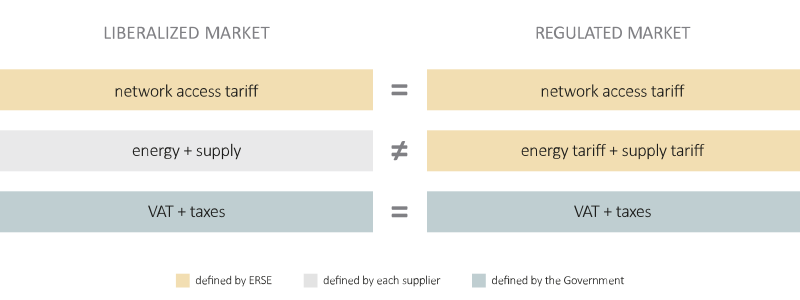
All consumers pay the network access tariff, regardless of whether they are in the regulated market or in the liberalized market. Access tariffs reflect the cost of infrastructures and all services used by all consumers in a collective manner. This tariff results from the sum of the global technical system operation tariff, the transmission network tariff, and the distribution network tariffs. ERSE defines all these tariffs.
Consumers, who are still in the regulated market pay the energy tariff and the supply tariff, set by ERSE. In the liberalized market, each supplier defines freely the corresponding price, being in competition with other suppliers.
The government is responsible for defining VAT and other taxes, which are the same across the regulated and the liberalized market.
To know more about the commercial offers in the liberalized market you can consult the Bulletin for the electricity retail offers.
Every six months, ERSE publishes information (PT) comparing energy prices in Portugal with other European Union countries' prices.
Tariffs and Regulated Prices
Annually, ERSE approves tariffs and prices for electricity, valid for a calendar year (January to December). Exceptionally ERSE can approve tariffs and regulated prices for a different timeline.
ERSE defines 'tariffs and regulated prices' as:
- Tariffs: regulated tariffs that reflect all the costs of each regulated activity. For these, ERSE defines the allowed revenues; all end-user consumers, both in the regulated and liberalized market, pay the network access tariffs.
- Prices: prices of regulated services are associated with mandatory services (for example: restoration of power supply or extraordinary meter readings) and are paid only by consumers who request them.
The Tariff Regulation, approved by ERSE, defines the methodology to determine the allowed revenues, the tariff methodology, and the tariff structure.
2026 Annual Setting
ERSE approves the tariffs and prices for electricity and other services in 2026 and Parameters for the 2026-2029 regulatory through ERSE Directive No. 1/2026 of 7 January.
The setting is based on the document ‘Tariffs and prices for electricity and other services in 2026 and Parameters for the 2026-2029 regulatory period’, which includes the following annexes:
- Regulatory parameters for the period 2026 to 2029
- Allowable revenues and adjustments for 2026 for regulated companies in the electricity sector
- Tariff structure for the electricity sector in 2026
- Characterisation of electricity demand in 2026
- Economic performance analysis of regulated companies in the electricity sector
- Benchmarking study of distribution network operators
The Tariff Council's Opinion and ERSE's comments on that Opinion are also available.
Tariffs and Prices 2026
- Electricity Tariff Tables effective from 1 January 2026 (Excel file)
- Regulated Price Tables effective from 1 January 2026 (Excel file)
Rules for allocating social tariff funding
The financing of social tariff costs is ensured by producers, suppliers and other market agents, under the terms of Decree-Law No. 15/2022 of 14 January, as amended by Decree-Law No. 104/2023 of 17 November. ERSE held public consultation No. 136 on the distribution of social tariff costs for 2026 and adjustments for previous years. The decision on the amounts to be borne by producers, suppliers and other market agents during 2026 was approved by Directive n.º 12-A/2025, 30 December.
Social tariff
Economically vulnerable consumers with a contracted power up to 6.9 kVA are entitled to a social tariff discount to be reflected in the network access tariff. This discount is identical across the regulated market and the liberalized market.
For consumers in the liberalized market, ERSE defines the social tariff discount applied to the network access tariff. When the consumer is entitled to the social tariff, the supplier must apply the discount to the final consumer prices.
For consumers who are still in the regulated market, ERSE defines an end-user social tariff, applied by the supplier of last resort (SLR).
ERSE has made available a calculator to check the social tariff discount on consumers' energy invoices.
See these FAQs for more information on the social tariff.
The General Directorate of Energy and Geology (DGEG) is responsible for identifying the beneficiaries of the social tariff. If you have any questions or complaints about the social tariff entitlement, please contact DGEG.
Time Periods
- Super off-peak
- Off-peak
- Mid-peak
- Peak
The price of electricity varies according to the time of day at which consumption takes place.
The hourly period corresponds to the way electricity consumption is distributed over the 24 hours of each day and the 7 days of the week.
The hourly periods for the delivery of electricity, set out in the ERSE´s Tariff Code, in Articles 34 for mainland Portugal and Article 40 for the Autonomous Regions, are as follows:
- Peak: applicable to consumers at all voltage levels and to normal low voltage (BTN) consumers on a three-hour tariff. It corresponds to the period when the price of energy is highest.
- Mid-Peak: applies to consumers at all voltage levels and to BTN consumers on the three- and two-hour tariff.
- Off-Peak: applies to consumers at all voltage levels and to BTN consumers on the three- or two-hour tariff. It corresponds to the period when the price of energy is lowest.
- Super off-peak: applicable to consumers connected to special low voltage (SLV), medium voltage (MV), high voltage (HV), and very high voltage (VHV).
In addition to the hourly periods, there are also two cycles: daily cycle (the hourly periods are the same every day of the year) and weekly cycle (the hourly periods differ between weekdays and weekends).
For each cycle, there is a summer and winter timetable. The time periods in mainland Portugal and the Autonomous Regions are determined by the specific electrical characteristics of each region, namely the evolution of its energy load diagram.
A normal LV electricity consumer (contracted power less than or equal to 41.4 kVA) can choose between 3 tariff options. Each period has different energy prices:
- Tri-hourly: 3 periods during the day (peak hours, mid-peak hours, and off-peak hours)
- Bi-hourly: 2 periods during the day (off-peak and peak hours)
- Simple: 1 single period during the day, with no energy price differentiation.
For more information see ERSE's energy price simulator.