ERSE held a ConvERSE on establishing a standard that reflects the appropriate level of security of supply for the electricity system in mainland Portugal
20/04/2026
On 13 April 2026, ERSE – the Energy Services Regulatory Authority – held a ConvERSE on the study and methodology used to define the reliability standard, a technical and economic benchmark that reflects the appropriate level of security of supply for the electricity system in mainland Portugal.
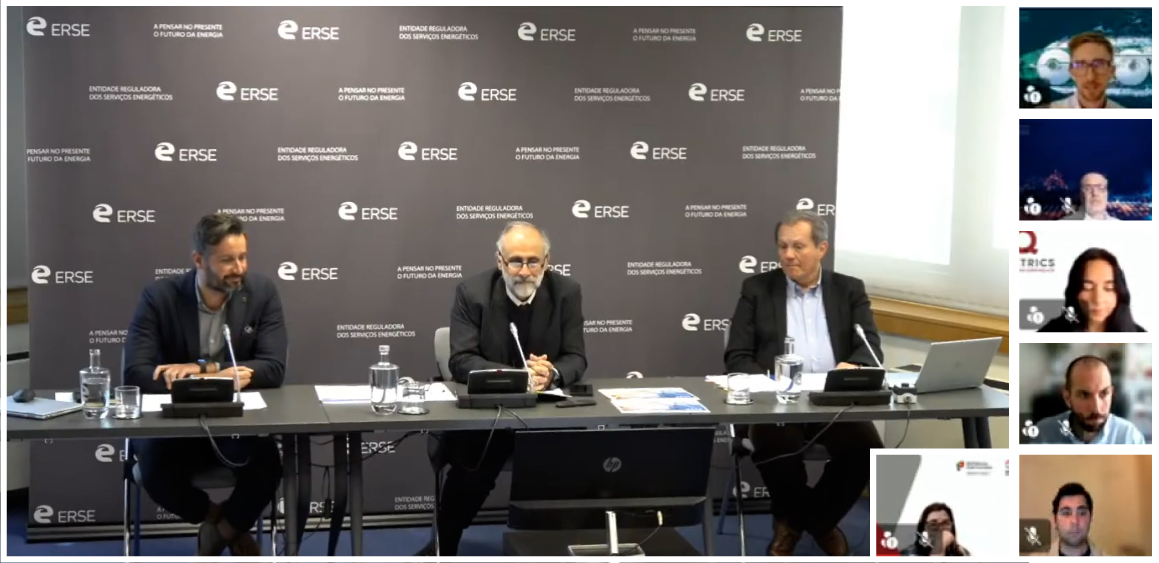
The online event was attended by a total audience of around 108 people, with the opening session led by ERSE’s President, Pedro Verdelho, and the closing session by ERSE’s Director, Ricardo Loureiro.
The Reliability Standard corresponds to the level of risk of supply interruption considered acceptable, and is used as a benchmark to assess the adequacy of the electricity system’s resources, i.e. whether it has sufficient capacity (whether in terms of generation, storage, or other resources, such as demand response) to meet electricity demand and, when applicable, to the sizing of capacity mechanisms. Its determination is based on an economic analysis that balances, on the one hand, the cost of securing additional capacity to reinforce the electricity system and prevent potential outages and, on the other hand, the cost that such outages represent to society in terms of electricity supply due to a lack of resources.
ConvERSE enabled the presentation of the study carried out by ERSE, at the request of the Directorate-General for Energy and Geology (DGEG), concerning the internal electricity market, which made it possible to estimate the Value of Lost Load (VOLL), i.e. how much an interruption in the energy supply costs to the consumer, and the Cost of New Entry (CONE), i.e. the cost of the investment required to strengthen the system and prevent interruptions, for mainland Portugal. These are key indicators for assessing security of supply and for defining the Reliability Standard for the national electricity system. Following this process, and following a proposal from ERSE, the DGEG set the Reliability Standard at 1.46 hours/year. According to Manuela Fonseca of the DGEG, this figure will guide the 2025 RMSA study (Security of Supply Monitoring Report), that is, it allows for the assessment, from a security of supply perspective, of the system’s investment needs in the medium and long term.
The study was carried out in accordance with the obligations arising from Article 25 of Regulation (EU) 2019/943 on the internal electricity market and in line with the methodology defined by the European Union Agency for the Cooperation of Energy Regulators (ACER), which was presented by Rafael Muruais Garcia and Aleksander Glapiak.
The session also featured the participation of the consultants involved in developing the study. Susana Justo, from Qmetrics, presented the methodology used for the questionnaires administered to domestic and non-domestic consumers to determine the VOLL.
Ignacio Cobo and Joaquim Amenabar, from AFRY, explained how they developed the proposed reliability standard for mainland Portugal.
Watch the explanatory video
Watch the video of the session
Access the presentations:
European Framework for Security of Supply Monitoring – Rafael Muruais Garcia and Aleksander Glapiak – ACER
Questionnaire methodology and the challenge of obtaining consumer responses for subsequent VOLL calculation – Susana Justo – QMETRICS
Determination of the Reliability Standard Indicator for Portugal - Ignacio Cobo and Joaquin Amenabar - AFRY